Material's Automated Discovery (MAD) Lab
We advance materials discovery using automation, machine learning, and data-driven approaches at NTNU.
Professor
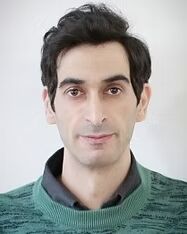
Bio Details
- Birthdate: December 15, 1982
- Nationality: S. Korea
- Current Position: Full Professor, NTNU
- Research Interests: AI for Materials Science & Engineering
Education
- 2012: PhD, Applied Chemistry, Damascus University (Syria)
- 2008: Master, Applied Chemistry, Damascus University (Syria)
- 2005: Bachelors, Pure Chemistry, Damascus University (Syria)
Experience
- 2013–2015: Postdoc, School of Materials Science & Engineering, Yeungnam University (S. Korea)
- 2015–2023: Assistant Professor, School of Advanced Materials Science & Engineering, Sungkyunkwan University (S. Korea)
- 2023–2025: Associate Professor, School of Advanced Materials Science & Engineering, Sungkyunkwan University (S. Korea)
Current Members


Alumni





Teaching
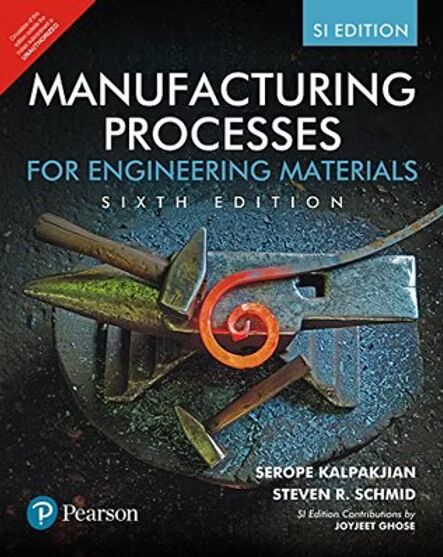
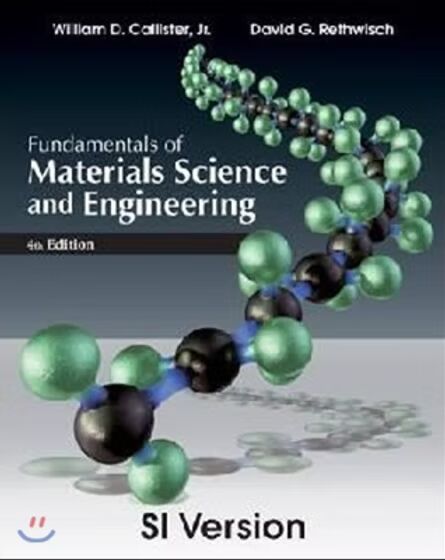
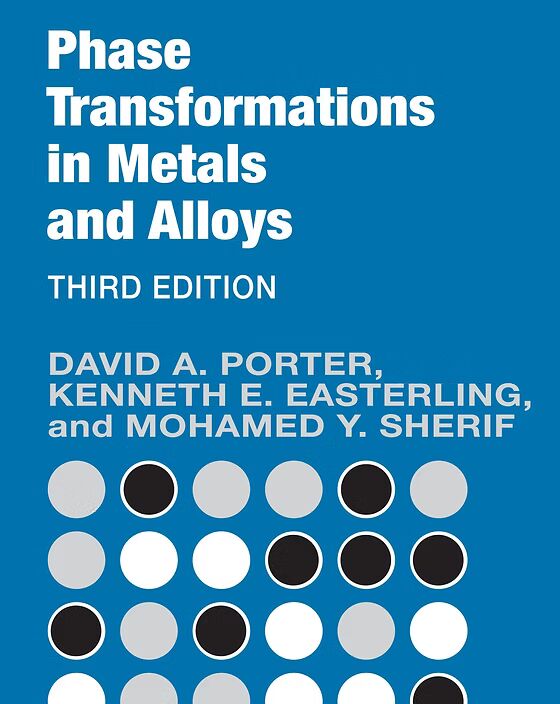
Courses

Teaching Awards

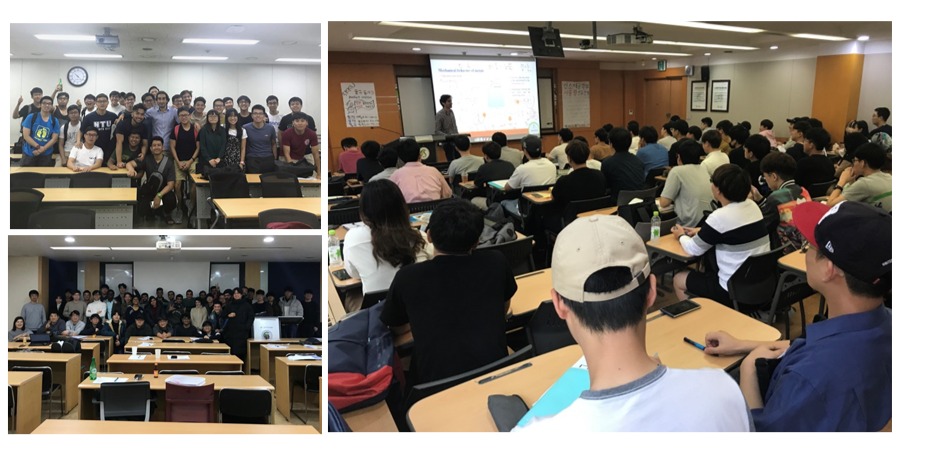
Over the years, I have been consistently recognized for excellence in teaching and student mentorship at the School of Advanced Materials Science and Engineering, Sungkyunkwan University (SKKU). I was honored as the 1st-ranked professor in educational performance in 2018, 2019, 2021, 2022, and 2023, the 2nd-ranked in 2024, and the 3rd-ranked in 2020. These awards reflect my continuous commitment to high-quality instruction, student engagement, and the development of innovative learning methods that inspire academic and professional growth.
Research
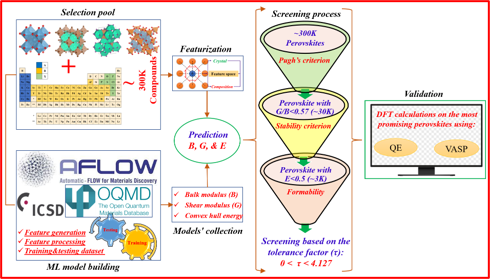
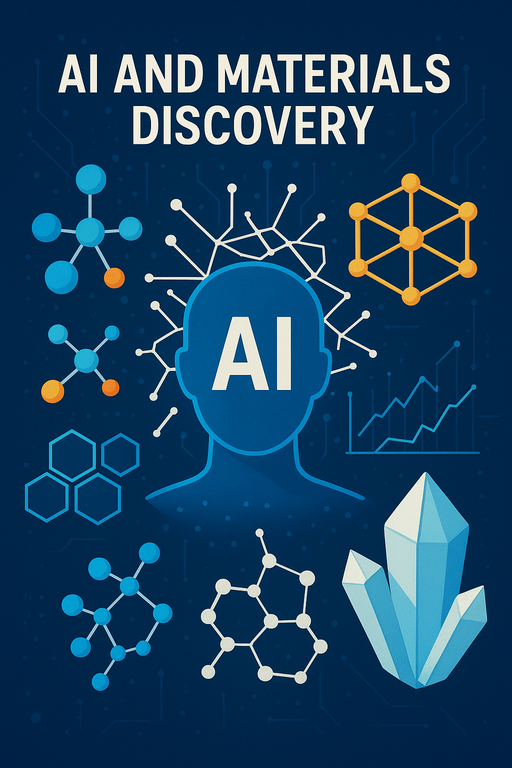
AI-Guided Materials Discovery
Our research focuses on accelerating the discovery and design of advanced materials through the power of Artificial Intelligence (AI) and data-driven modeling. Traditional materials development is often a slow and resource-intensive process. AI offers a transformative approach by enabling rapid prediction, optimization, and understanding of material properties before experimental synthesis.
In this activity, we apply machine learning, deep learning, and computational modeling to explore a wide range of material systems, including aluminum alloys, energy storage materials for metal-ion batteries, and high-performance perovskites for solar energy harvesting, as well as superhard materials.
By integrating AI with high-throughput simulations and experimental data, we aim to uncover new compositions, predict structure–property relationships, and guide the rational design of next-generation materials for sustainable technologies.
Our goal is to build intelligent frameworks that not only accelerate discovery but also enhance interpretability and innovation in materials science, driving breakthroughs across energy, structural, and functional material domains.
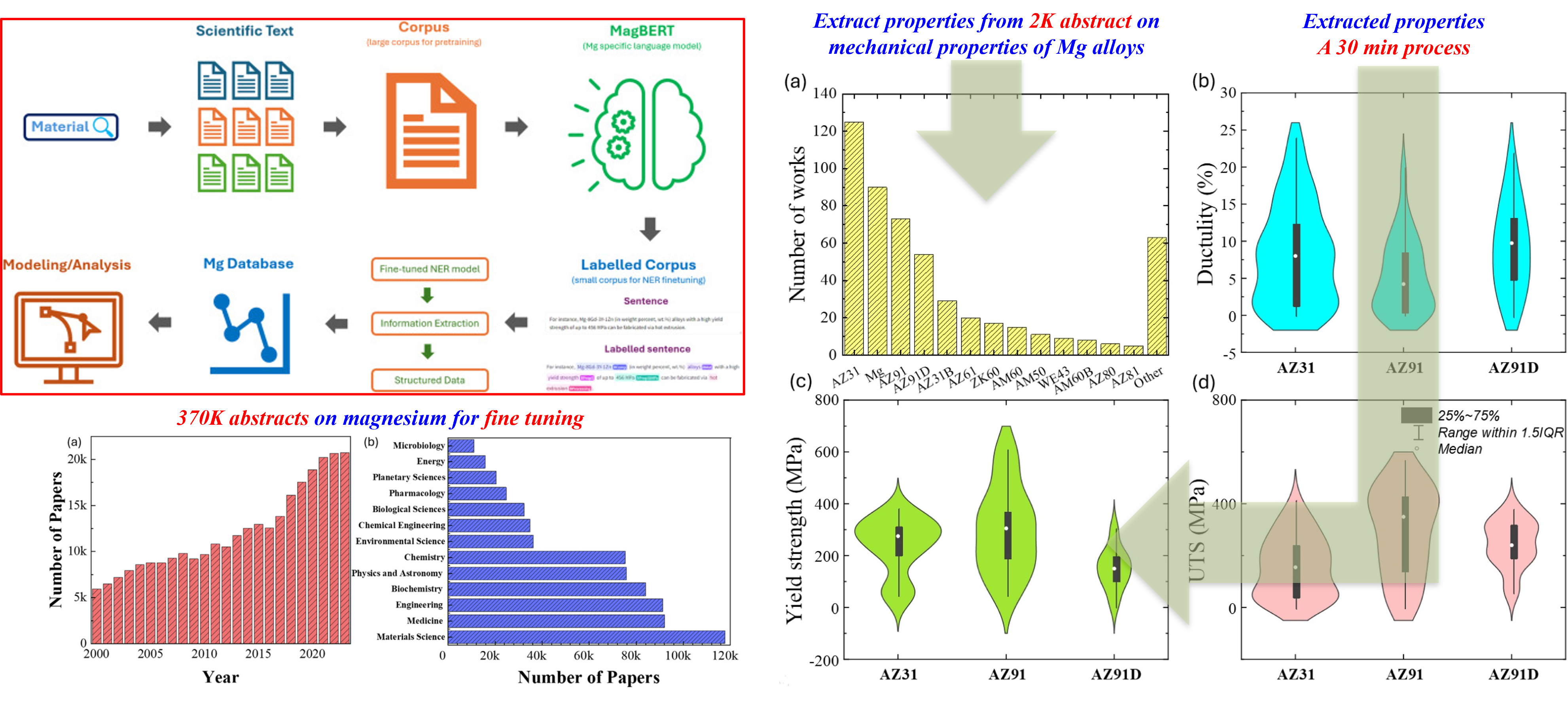
AI-Driven Scientific Text Mining
Our research leverages Artificial Intelligence, particularly Large Language Models (LLMs), to extract and organize scientific knowledge from the vast body of published literature. Traditional literature review and data collection are time-consuming and prone to oversight; AI-driven text mining enables rapid, accurate extraction of critical insights, trends, and material-specific data.
We have applied this approach to magnesium alloys and are currently focused on building FAIR (Findable, Accessible, Interoperable, Reusable) datasets for hydrogen embrittlement, aluminum alloys processing and casting, and many other material systems.
By combining AI with structured data curation, we aim to create high-quality, standardized datasets that accelerate materials discovery, enable data-driven modeling, and support reproducible research across the materials science community.
Collaboration
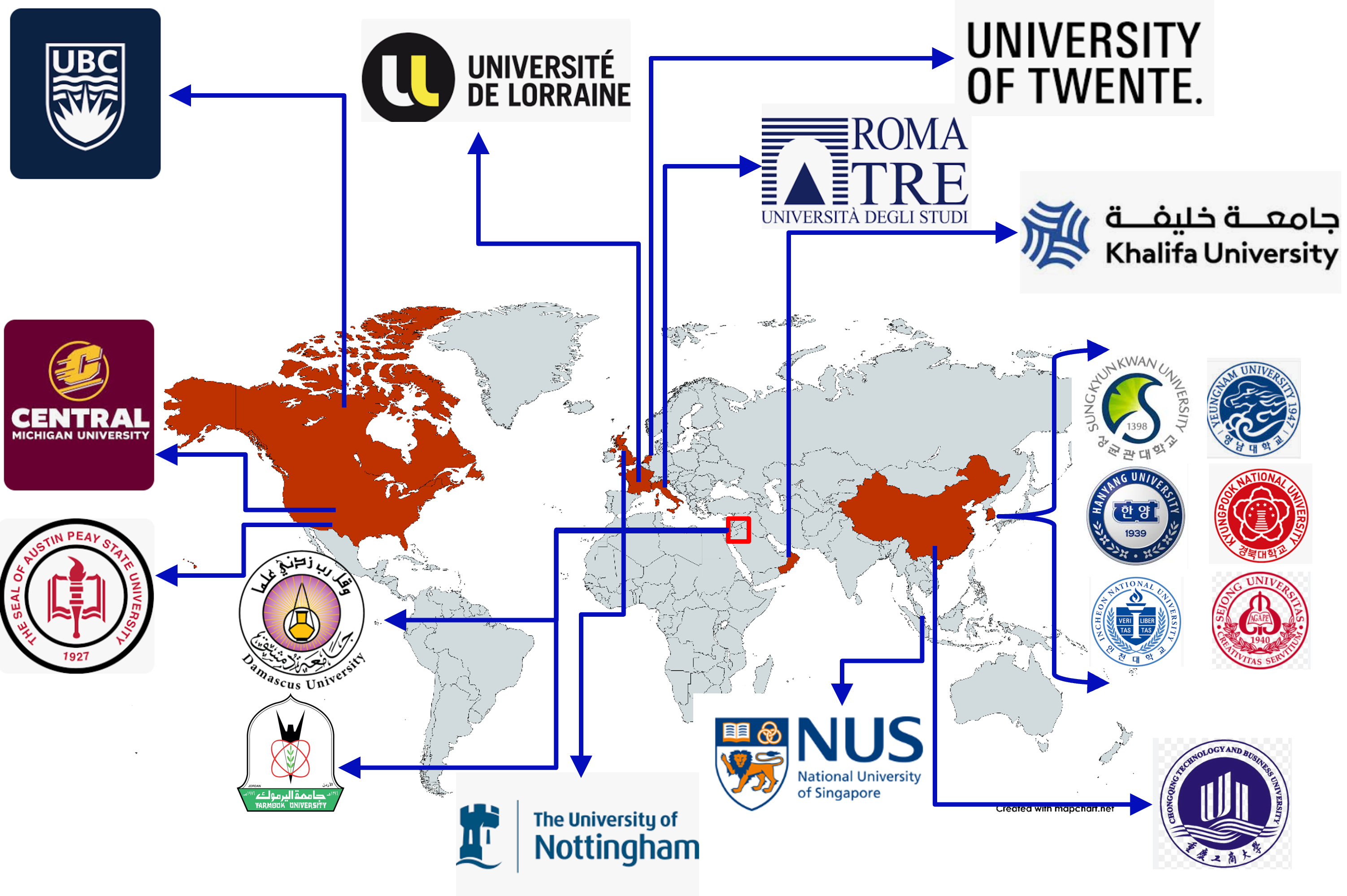
We have collaborated with more than 20 universities across the world, fostering strong international partnerships that advance innovation in materials science and artificial intelligence.
Selected Publications
2025
- Chaudry, Umer Masood; Rehan Tariq, Hafiz Muhammad; Hamad, Kotiba; Khan, Muhammad Kashif; Jun, Tea-Sung. Twinning-induced texture weakening in Mg alloy and its consequent influence on ductility and formability. Materials Science and Technology, 41(2), 101–105, 2025. SAGE Publications, London, England.
- Jaafreh, Russlan; Kumar, Surjeet; Hamad, Kotiba; Kim, Jung-Gu. Introducing Materials Fingerprint (MatPrint): A novel method in graphical material representation and features compression. Computational Materials Science, 246, 113444, 2025. Elsevier.
- Alzamer, Haneen; Jaafreh, Russlan; Kim, Jung-Gu; Hamad, Kotiba. Artificial Intelligence and Li Ion Batteries: Basics and Breakthroughs in Electrolyte Materials Discovery. Crystals, 15(2), 114, 2025. MDPI.
- Chaudry, Umer Masood; Farooq, Ameeq; Sufyan, Muhammad; Tariq, Hafiz Muhammad Rehan; Malik, Abdul; Kim, Minki; Tariq, Ali; Hamad, Kotiba; Jun, Tea-Sung. Corrosion behavior of AZ31 and AZ31–0.5 Ca in different concentrations of NaCl and Na₂SO₄ at various temperatures. Corrosion, 81(3), 232–244, 2025. Association for Materials Protection and Performance.
2024
- Mahendradhany, A.P.; Park, K.S.; Widiantara, I.P.; Kim, Min Jun; Oh, J.M.; Kang, J.H.; Hamad, K.; Ko, Y.G. Achieving high strength and ductility of multi-phase steel via hub-border architecture formed in 30 s. Journal of Alloys and Compounds, 972, 172774, 2024. Elsevier.
- Jaafreh, Russlan; Pereznieto, Santiago; Jeong, Seonghun; Widiantara, I. Putu; Oh, Jeong Moo; Kang, Jee-Hyun; Mun, Junyoung; Ko, Young Gun; Kim, Jung-Gu; Hamad, Kotiba. Phonon DOS‐Based Machine Learning Model for Designing High‐Performance Solid Electrolytes in Li‐Ion Batteries. International Journal of Energy Research, 2024(1), 2138847, 2024. Hindawi.
- Choi, Hyung Wook; Kim, Jiwon; Bang, Hyeon-Seok; Badawy, Khaled; Lee, Ui Young; Jeong, Dong In; Kim, Yeseul; Hamad, Kotiba; Kang, Bong Kyun; Weon, Byung Mook. Tracking accelerated oxygen evolution reaction enabled by explosive reconstruction of active species based on CoxN@NC. Journal of Materials Chemistry A, 12(12), 7067–7079, 2024. Royal Society of Chemistry.
- Jaafreh, Russlan; Kim, Jung-Gu; Hamad, Kotiba. Utilizing machine learning and phonon density of states for innovative approaches to design and optimize high-performance solid-state Mg-ion electrolytes. Journal of Power Sources, 606, 234575, 2024. Elsevier.
- Kumar, Surjeet; Jaafreh, Russlan; Dutta, Subhajit; Yoo, Jung Hyeon; Pereznieto, Santiago; Hamad, Kotiba; Yoon, Dae Ho. Predictive modeling of critical temperatures in magnesium compounds using transfer learning. Journal of Magnesium and Alloys, 12(4), 1540–1553, 2024. Elsevier.
- Dutta, Subhajit; Panchanan, Swagata; Kumar, Surjeet; Jaafreh, Russlan; Yoo, Jung Hyeon; Kwon, Seok Bin; Hamad, Kotiba; Dastgeer, Ghulam; Yoon, Dae Ho. Pure Tunable Emissions from Cesium Manganese Bromide by Monitoring the Crystal Fields Through a Sustainable Approach. Advanced Sustainable Systems, 2024. Wiley.
- Kumar, Surjeet; Jaafreh, Russlan; Singh, Nirpendra; Hamad, Kotiba; Yoon, Dae Ho. Introducing MagBERT: A language model for magnesium textual data mining and analysis. Journal of Magnesium and Alloys, 12(8), 3216–3228, 2024. Elsevier.
- Gurjar, Kuldeep; Kumar, Surjeet; Bhavsar, Arnav; Hamad, Kotiba. An Explainable Deep Learning-Based Classification Method for Facial Image Quality Assessment. Journal of Information Processing Systems, 20(4), 2024.